
Internal Affairs
An open studio on the home in Palestine
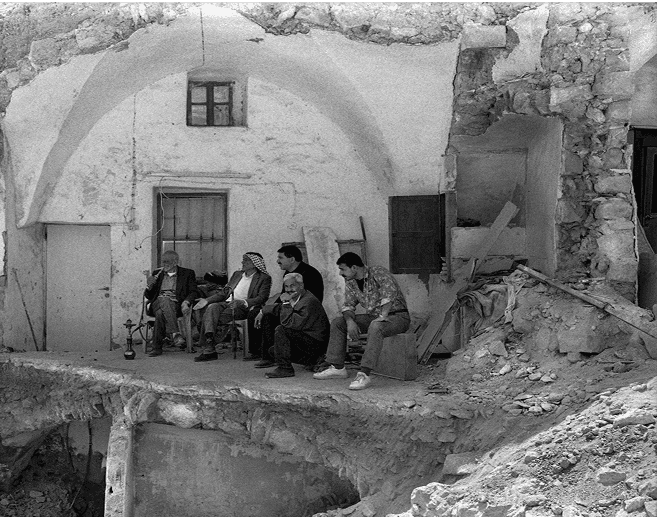
Source: Joss Dray Collection, Palestinian Museum Archive.
"Internal Affairs: An Open Studio on the Home in Palestine" is a programme of multimedia, transdisciplinary workshops on the basic component of Palestinian urban life: the home. The programme explores what the home holds as a material, social and political space — meanings, vocabularies, knowledge, ways of living, relations and spatial politics belonging to Palestine's communities across their diverse geography — by developing cultural and urban practices around it with a young generation of students and specialists from a range of fields.
Since the Nakba the home has carried a symbolic and philosophical weight, holding within it meanings of loss, steadfastness, memory and resistance among many others — as we find across literary, artistic, philosophical and anthropological work. The open studio regards the home as a space for exploring many concepts and ideas about urban life, society and Palestinian history, and for understanding the social, economic, political and also environmental systems that impose their conditions on the production of Palestinian patterns of dwelling and living across many historical periods and events.
Participants use the home as an instrument, or an urban lens, for reading the reality of living and for engaging questions about the dynamics through which society is produced: about its private and shared space and the means of its steadfastness and sustainability on the land, and also for enriching the imagination with new vocabularies and relations.
The project is one of the founding activities of Koor, a studio for research, design and learning on architecture and urbanism in Palestine, which aims to develop new tools and knowledge resources that engage younger generations in architecture, the arts and the humanities around critical, active questions about architecture and urbanism, spatial practices and relations, and traditional, modern and contemporary communal ways of living. We see in this a latent opportunity to enrich the contemporary production of urban life and of spatial practices for Palestinians.